Daycare for Sale in Texas: What Actually Kills ROI
Buying a daycare in Texas requires more than capital. For high-net-worth investors, rigorous daycare site selection in Texas is the ultimate defense against operational failure. We skip the generic narrative about population growth. Instead, we expose hidden daycare business risks. These structural signals determine your long term return on investment.
Why Daycare Site Selection in Texas is the Ultimate Risk Filter
Texas shows explosive growth right now. People arrive daily. Working parents fill new subdivisions every month. Yet, raw human presence does not guarantee success for a daycare center.
Standard location analysis stops at raw population numbers. Sophisticated investors hunt for structural friction.
1. The Population Illusion: Raw Growth vs. Real Seat Gaps
A typical listing highlights 5,000 children within a three-mile radius. This is a static number. It ignores micro-market competition density. Relying solely on total population to evaluate a market creates significant blind spots. Without understanding local capacity, this misalignment severely compresses your daycare ROI in Texas.
Looking only at population hides the true market signal. High-population zones often lead to rapid daycare market saturation. We compare population rankings against the actual seat gap. The table below shows three typical Houston suburbs. The highest population does not equal the best opportunity.
For example, Katy (77449 and 77494 in Harris/Fort Bend) ranks in the top three for under-five population statewide. Yet, neither makes the top seven for actual seat shortages. Meanwhile, Dallas (75217) ranks seventh in raw population but holds the #1 spot for capacity shortage in Texas, missing over 7,300 seats. The chart below visualizes this critical mismatch.
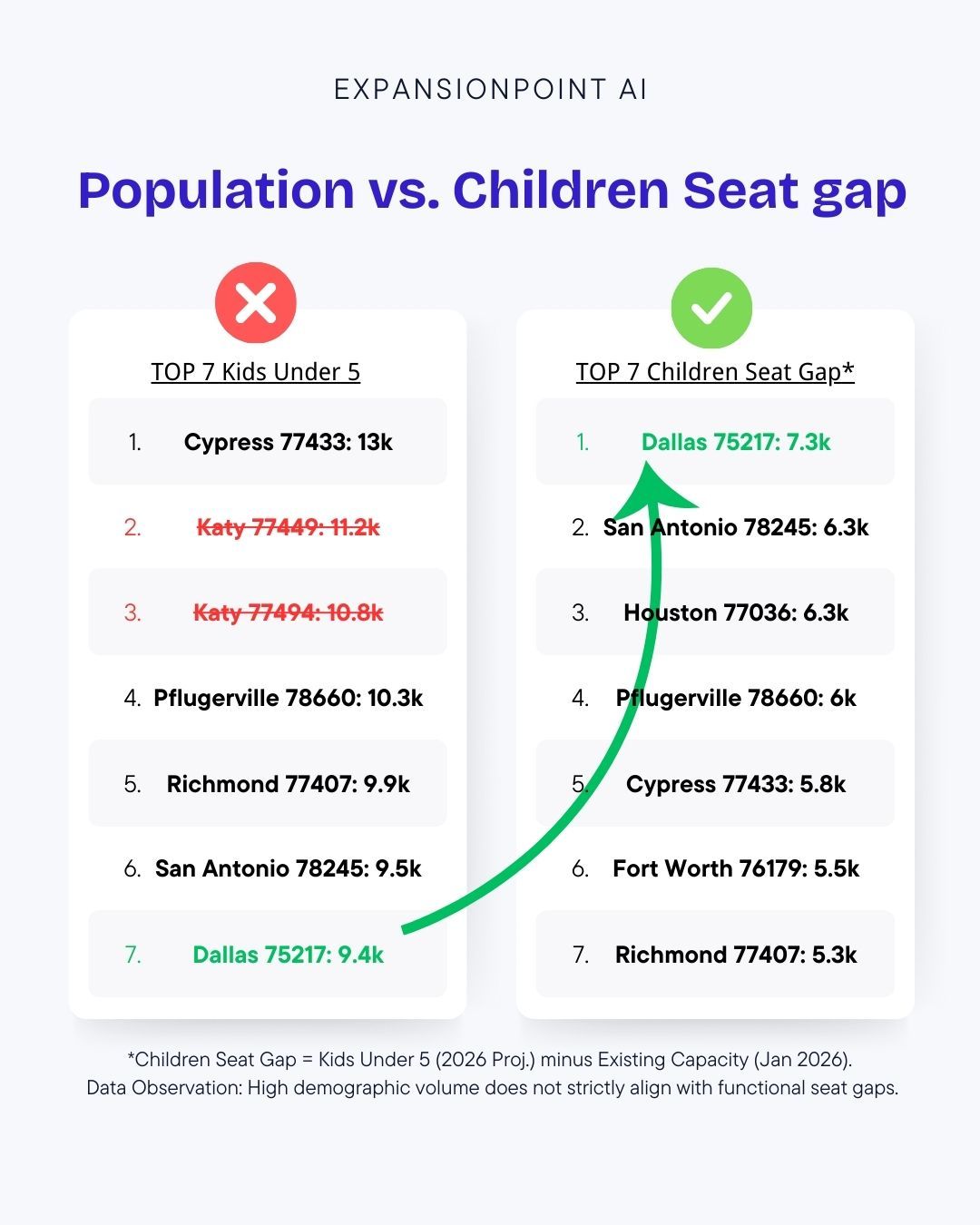
This is not a mere numbers difference. It is a market entry miscalculation.
If your model relies solely on population size, this analysis ends here.
2. The Capacity Trap: 0-4 Years vs. Functional Seat Gaps
Investors often focus on total building size. They rely on standard demographic reports to estimate demand. These generic reports create a dangerous illusion of accuracy. They lump children into broad "0-4 years" categories.

A six-month-old infant and a four-year-old preschooler require entirely different space ratios and staffing costs. Building a floor plan based on a generic "0-4" bucket is a massive operational risk. Site selection requires breaking down this block into functional age segments.
For example, a standard report shows over 11,000 children under five. A detailed micro-analysis breaks this down into actionable demand signals:
| Kids under <5 est. | Infant | Toddler | Preschooler |
| 11,235 | 4,294 | 3,683 | 3,258 |
*Source: ExpansionPoint AI Proprietary Projections (Dec 2025)
*View Katy (77494) Market Snapshot →
Sometimes, a market shows a negative overall seat gap. This does not automatically signal a bad market. A seemingly full market might still lack care for certain age groups, as competitors often skip these specific gaps due to their brand choices or operational limits.
Comparing specific age-group population against local capacity reveals these hidden opportunities.
Matching your room structure to exact local needs prevents high vacancy rates. Failing to do so creates massive operating waste and becomes a primary ROI killer.
3. The Capital Stress Test: Cash Flow vs. Structural Resilience
A triple net lease carries hidden fragility. Base rent and operating expenses climb with local inflation. Before committing to SBA loans for daycare, you must test your model. An investor should project cash flow at a 50% enrollment rate. This test protects your personal guarantee during early operations.
High-end franchise data reveals a clear ceiling. Rent costs above 15% of annual revenue cap the exit valuation. A profitable center loses its valuation multiple if the lease structure is too heavy. You need healthy EBITDA for childcare to survive a slow ramp-up phase.
| Expense Category | % of Revenue (High-End Reference) | Status |
| Labor Costs | 43% - 50% | Core Expense |
| Occupancy Expenses | 15% - 20% | Warning Line |
| Franchise / Mgmt Fee | 6% - 10% | Non-negotiable |
| EBITDA (Margin) | 11% - 23% | Benchmark Target |
This is not a profit target. It is a structural defense.
4. The Affordability Mismatch: Wealth Pockets vs. Price Sensitivity
Financial capacity is a fact. Price sensitivity is a local sentiment. A site located two miles away from a "wealth pocket" faces a trust distance problem. Service and market mismatch is a classic ROI killer.
Setting premium tuition in a price-sensitive zone slows enrollment. This high cost deters families in mid-market zones. Building premium facilities in the wrong micro-pocket drains cash flow quickly.
This is not a pricing choice. It is a micro-market alignment.
5. The Timeline Signal: Historical P&L vs. Asset Survival
A past financial performance statement is backward-looking. It records achievements in a market that may no longer exist in the future. Texas markets peak rapidly. Parts of mature communities in Spring have already hit their growth ceiling.
You are buying a future, not a history book. This requires observing the invisible pipeline. A new residential construction project nearby changes everything. If 3,000 acres develop within two miles, the supply-demand gap vanishes. Conversely, a competitor's new permit impacts your eventual sale price. Professional business appraisers often miss these hyper-local future threats during standard business valuations.
Tracking these signals creates an early advantage. During the delivery phase, targeted marketing captures new families before competitors open their doors.
This is not a financial review. It is a survival projection.
Next Step: See These Risks Filtered in a Real Deal
We applied this specific risk-mitigation framework to a $4.5M acquisition scenario in Waxahachie. See how a "raw seat gap" of 1,200 seats narrows down to a specific addressable target once we apply the Nanny Filter.
👉 Read the Waxahachie Due Diligence Case Study
Underwrite Before You Sign
Stop guessing with raw demographic data. In a million-dollar acquisition, a standard report is not enough. Review our structured data format to see how we measure the variables that brokers ignore.
Disclaimer: The analysis and risk factors presented here are for educational purposes. They reflect modeled estimates and should not be taken as financial or investment advice.