Data-Driven Daycare Market Intelligence & Site Selection
You don't need a GIS expert.
Scout markets, identify red flags, and stress-test your daycare expansion in minutes.
These are the operational questions that actually matter.
1. Site / entry decision
- Should I open here?
- Should I acquire this center, or pass?
- What size school can this market realistically support?
2. Operating / enrollment fit
- Can this market support premium tuition?
- Is this enrollment issue internal, or market-driven?
- Which operating model or brand positioning makes sense here?
3. Timing / market risk
- Will future supply compress my margin?
- How can I monitor saturation trends over time?
- Is this market getting stronger, or is it time to exit?
Why These Decisions Are Easy to Misread
Outdated & Half-Blind Metrics
Traditional tools show where families live, but ignore updated competitor supply and future housing development. Evaluating a site without knowing the addressable childcare gap means you are flying blind.
Gut Feeling & Intuition
Relying on “gut feeling” is a high-stakes gamble. In a data-driven world, intuition without verification leads to misaligned expectations, putting your business at risk.
Biased Deal Momentum
Many site decisions inherit bias from third-party incentives, incomplete local knowledge, or deal momentum. Without independent validation, those inputs can push operators toward the wrong site, the wrong price, or the wrong growth thesis.
How ExpansionPoint Clears the Path
Our intelligence engine analyzed 14,000+ historical daycare sites to map exactly how local demand, competitive density, and future housing impact enrollment. Stop guessing, and filter your next decision through this battle-tested framework.

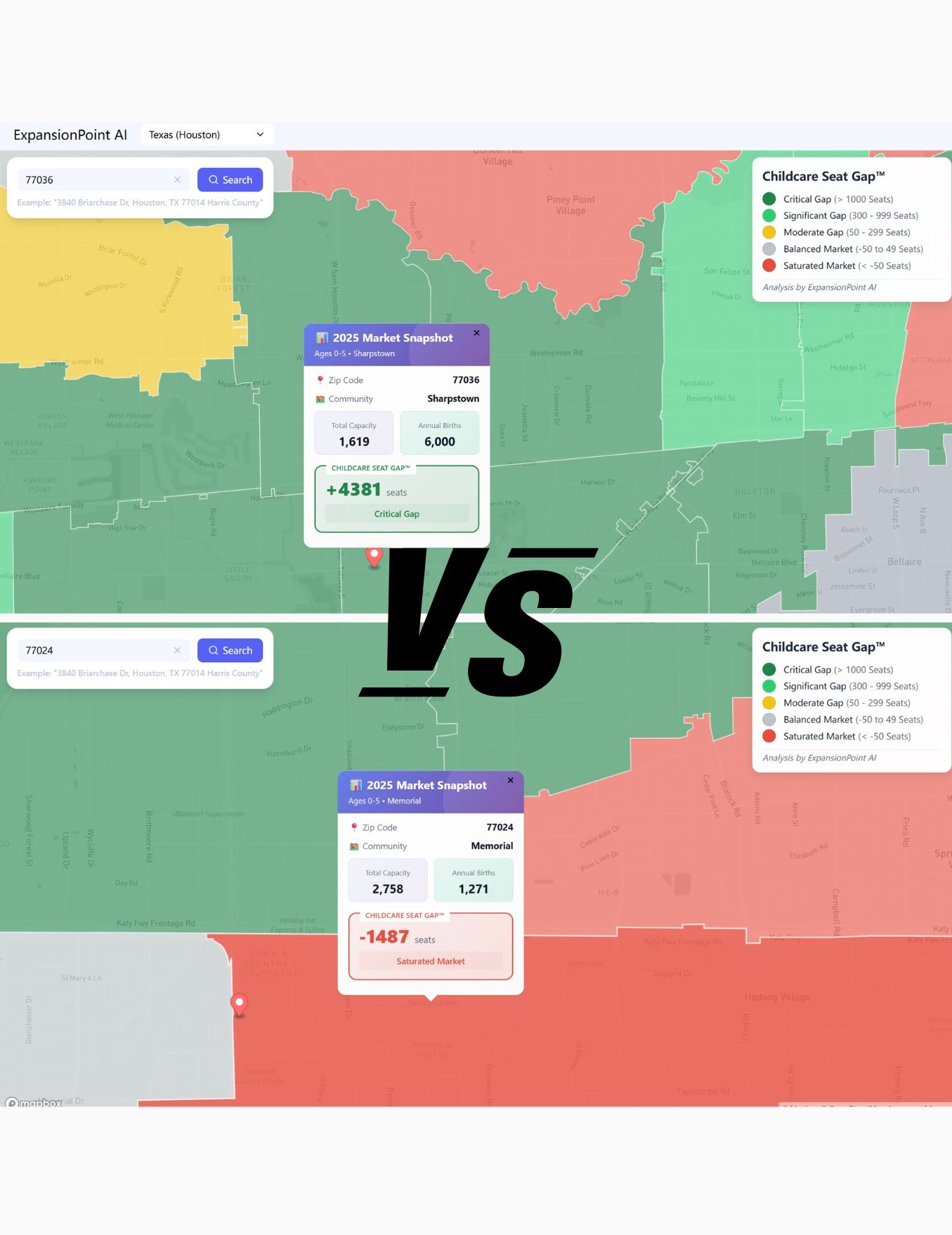
1. Market Saturation & Seat Gap
See whether a market is truly high-demand, or just looks attractive on raw demographic demand.

We analyze licensed capacity, center openings and closures, and supply volatility to estimate the true childcare seat gap in a target trade area.

- Gap visibility: See where unmet demand may still exist.
- Competitive pressure: Understand where supply is expanding, shrinking, or already fully allocated.
- Trend: Evaluate market direction, not just a static snapshot.
2. Addressable Demand by Age and Care Behavior
Move beyond “kids under 5” and estimate the families who are actually likely to use paid childcare.

We segment demand by age group and adjust for local care behavior, including nanny usage and stay-at-home parent patterns, to better estimate true capturable demand.

- Age-level demand: Break demand into infants, toddlers, and preschool.
- Care behavior adjustment: Avoid overstating demand in markets where private care substitutes are common.
- Demand calibration: Turn raw child counts into a more realistic view of demand at your tuition level.

3. Micro-Location, Wealth & Commuter Fit
A daycare site is not defined by ZIP-code averages alone. We analyze hyper-local household wealth, traffic access, and employment inflow to understand whether a location is both financially supportable and operationally convenient for working parents.

- Wealth visibility: Identify whether nearby households can realistically support your tuition model.
- Commuter access: See how traffic corridors and daily routes affect site convenience for working parents.
- Employment inflow: Understand whether nearby job centers may expand demand beyond the immediate neighborhood.

4. Future Development & Demand Signals
A site decision should reflect where demand and competition are heading, not just where they stand today.

We track residential development, zoning activity, and permit signals to identify where future household growth or new supply may change the market over time.

- Forward-looking demand: See where future household growth may support enrollment.
- Supply watch: Monitor where new competitive supply could emerge.
- Timing insight: Understand whether the market is strengthening, peaking, or becoming more competitive.

5. Capacity & Tuition Fit
Test whether the market can support your planned school size, tuition strategy, and operational goals.

We use site-level market indicators to evaluate whether a location is better suited for a smaller format, a larger campus, or a more premium pricing strategy.

- Capacity fit: Evaluate whether the market supports a smaller footprint or a larger-scale center.
- Pricing fit: Test whether local demand can realistically support your tuition model.

See Why Owners & Development Teams Choose Us
Empowering early education leaders and independent franchisees across the nation's top brands, including Primrose Schools, The Goddard School, and Wize Academy.
Use Case

For Daycare Owners
Used to assess the performance of multiple locations, identify areas for improvement, and evaluate expansion opportunities and risks based on market data.

For Franchisors / Development Team
Applied as a standardized data input to support internal site screening and expansion discussions across multiple candidate locations.
FAQs
What makes this different from generic market reports?
Generic reports are static, outdated, and lack context. They typically deliver 2-year-old census data in a "pay-to-peek" PDF, showing gross demographics while ignoring live competitor supply and upcoming residential developments. Relying on these isolated numbers often leaves operators relying on blind guesswork or biased deal momentum.
ExpansionPoint is a live-scouting, dynamic workspace. Instead of static PDFs, our application layers up-to-date demographics with future housing signals to reveal the addressable seat gap. We replace gut intuition with smart capacity planning, giving you instant, verified visibility to pressure-test site feasibility before finalizing your expansion plans.
How accurate is the site-level data?
Our platform systematically aggregates data from verified public, commercial, and state licensing sources.
While our intelligence engine dynamically updates these datasets to provide the most current market visibility possible, the outputs reflect conditions at the time of your search and do not guarantee future operational performance.
Who typically uses this?
This daycare market intelligence application is commonly used by multi-site operators, franchisees, and growth teams evaluating a specific daycare site for a major commercial expansion. It is most often referenced during lease evaluations, footprint planning, or internal strategic planning where clearer market visibility is required.
Is this a go/no-go recommendation?
No — but it sharpens it. We highlight where the market supports your model — and where it doesn’t — so you can move forward (or pivot) with clarity.