Is Buying a Daycare for sale in Texas a Good Investment?
Macro Growth vs. Micro Demand
Texas is a compelling state for childcare operators. Families are moving in steadily, and the birth rate exceeds the national average.
Many owners see population growth as a sign of quick success. But there is a key issue: overall growth does not ensure local demand. For childcare investment, the coordinate determines success.
It is the difference between scaling on "easy mode" and struggling in "hard mode".
When applying for daycare loans and grants or SBA financing, the stakes are high. Trusting your gut can put your personal assets at risk. Without a daycare site audit, you may be buying a liability instead of a long term asset.
To avoid the trap, a structured audit typically moves four critical logic gates:
- The High-End Seat Gap: Moving from volume to value.
- The Behavioral Filter: Distinguishing ability to pay from willingness to enroll.
- The Time-Lag Trap: Monitoring the residential and competitive pipeline.
- The Exit Strategy: Ensuring a high daycare valuation from day one.
The High-End Seat Gap: Volume vs. Value
Professional auditing moves past raw population counts to identify the Children Seat Gap. Successful growth depends on finding a real shortage of licensed spots, similar in concept to the childcare desert reports published by the Texas Health and Human Services.
This matters whether you are looking at a new building or a business for sale. It is about more than just counting children; it is the first gate of professional expansion.
However, even a generic gap is a blunt instrument. A volume shortage does not necessarily translate into pricing power.
In the Texas childcare market, a seat is a financial commitment, not a commodity. To find a good childcare investment, you need to focus on the high-end seat gap. This gap is the lack of premium spots for families who can actually convert.
The contrast is absolute: A generic shortage is a statistic; a high-end gap can support durable enrollment. When you apply this filter, markets that appear "high-demand" often reveal themselves as saturated. Without distinguishing between ”any kid” and ”the right kid,” your enrollment and daycare valuation both weaken.
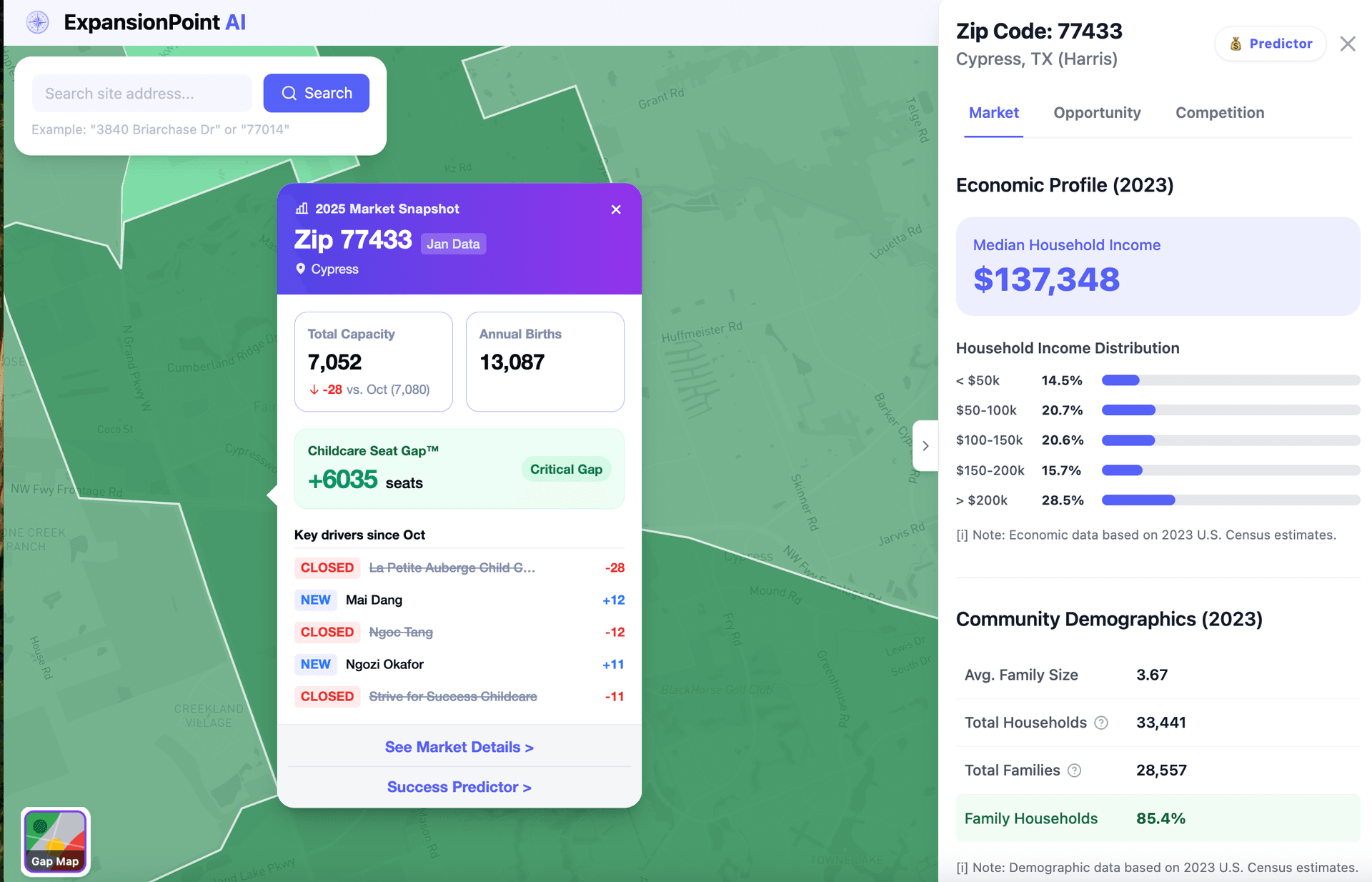
Case in Point: In Zip 77433 in Cypress, projected 0–5 population reaches 13,087, against 7,052 licensed seats — a reported Childcare Seat Gap™ of +6,035 seats. Median household income exceeds $137,000, placing a large share of families in the premium-supportable range.
On the surface, the signal is expansionary. Whether it translates into enterprise value depends on isolating the high-end seat gap.
View Cypress Market Signal Portfolio
The Behavioral Filter: Ability vs. Willingness
In high-wealth pockets of the Texas daycare market, affluence does not automatically equal enrollment. High household income often finances the most formidable competitor to institutional care: the private nanny. This is the "Nanny Filter"—a behavioral barrier that can quietly erode the revenue projections. In these submarkets, parents often prioritize personal care over early schooling for as long as possible.
The divide is between ability to pay and willingness to enroll. Ability is a financial fact; willingness is a narrative outcome. In the first 24-month cycle, parents buy "Tactile Trust". They need to feel certain that their child is loved and safe.
Ignoring this psychological preference inflates the actual market size.
A professional daycare site audit must include a Behavioral Filter to obtain the true "addressable demand" of a community. Failing to account for this behavioral lag is the quickest way to enter a structural trap. This directly impacts your real estate value and your eventual daycare exit price.
Case in Point: In the Kingwood area (77345), despite a "Critical Gap" in seats and 51.9% of households earning $150k+, the Median Nanny Penetration signal warns that high income can easily pivot toward private care, making a behavioral discount essential to find the true enrollment floor.
View Kingwood Market Signal Portfolio
The Time-Lag Trap: Now vs. Future
The most dangerous variable in the Texas daycare market is the 24-month construction lag. This includes the complex process of Texas daycare licensing and commercial construction. For operators building from the ground up, the market today is not the market you will enter. It is not an investment in today’s seat gap; it is a bet on a timeline.
Today’s Snapshot vs. Tomorrow’s Pipeline. A sound auditing framework must track the "Invisible Pipeline". This isn't just about spotting competitors; it’s about mapping residential growth. By watching when families move in, you can time your marketing and opening to meet them exactly when they arrive.
This analysis is for the operator capable of anticipating market shifts. If your due diligence only looks at a static snapshot, you are already behind. Without a forward-looking lens, your commercial daycare real estate is merely a bet on hope. With one, it becomes a well-timed, long term plan.
The Exit Strategy: Valuation Is Built on Predictable Cash Flow
The final gate is knowing your daycare valuation before you even open. Are you building a business that someone else will want to buy? And valuation is driven by two forces:
- Future cash flow
- Risk
Sophisticated buyers do not pay for what your daycare earned last year. They pay for what they believe it can reliably earn over the next five.
That belief starts with predictability.
In childcare, predictability is not marketing. It is structural. It comes from:
- stable enrollment driven by demographic demand
- a measurable seat gap in your submarket
- defensible tuition relative to household income
- manageable labor dependency
This is where most operators misunderstand valuation. Your P&L does not begin with revenue. It begins with location-level supply and demand math.
If your site sits in a submarket with a durable future seat gap, enrollment is not a question mark—it is a structural advantage. That reduces perceived risk, which increases valuation multiples.
Without predictable cash flow, your center is simply a building with licenses.
With predictable and defensible cash flow, it becomes an asset buyers compete for.
Before you sign an SBA loan, the real underwriting question is not “Can this business survive?”
It is: Will this location produce durable cash flow with manageable risk when a future buyer underwrites it?
If you are evaluating a childcare asset backed by SBA financing, the most important work happens before conviction forms—at the market level, not the P&L level.
Because valuation is not created at exit. It is engineered at site selection.
Next step: A Real-World Underwriting Breakdown
How does this structural logic apply to a real Texas deal? We analyzed a $2M–$8M acquisition scenario in Waxahachie to show how to calibrate risk before signing a personal guarantee.
👉 Read our Step-by-Step Waxahachie Due Diligence Case Study
Before You Sign an LOI or SBA Loan
In the childcare industry, location is not a guess. It is a data decision. If you are evaluating a lease or an acquisition, review our structured data format first.