Daycare Investment Underwriting Guide: Acquisition, Lease-Up & Ground-Up (Texas Case Study)
Most daycare investors start underwriting with one number: population. That number is usually wrong. Professional childcare investors evaluate structural signals before committing capital.
Childcare underwriting is no longer a simple population count. It is now a surgical data exercise. Successful daycare site selection in Texas now requires a move beyond static census data to a dynamic, risk-adjusted underwriting stack.
How Do Investors Underwrite a Daycare Investment?
Daycare investment underwriting stack typically includes five core steps:
- Catchment Area Demand Analysis (10-minute drive-time market)
- Strategic Positioning and Tuition Alignment
- Labor Ratio and Classroom Economics
- Physical Asset Compliance
- Entry Model Financial Stress Test (Acquisition, Lease-Up, or Ground-Up)
Professional investors analyze these five layers together before committing capital.
Step 1: Catchment Area Dynamic Analysis (10-Minute Drive-Time)
Standard location analysis often fails by relying on gross population counts. Professional underwriting requires calculating the Addressable Seat Gap (ASG) . In simple terms, you aren’t just looking for "how many kids live here." You are looking for the seats that are actually available to be captured.
The ASG Calculation Logic: Instead of a simple headcount, we apply three layers of filtration:
- Gross Demand (P): All children under 5 within a 10-minute drive-time.
- Effective Capacity (C): Total licensed slots, adjusted to exclude part-time or after-school programs that don't compete for full-day enrollment.
- The Nanny Filter (f): This is our proprietary adjustment for high-income segments.
In many Texas markets, household income levels dictate care preferences. In affluent pockets, the "capture loss"—children staying in home-based or nanny care—can reduce addressable demand by as much as 50%.
A negative ASG indicates structural oversupply. This significantly compresses your projected daycare investment ROI in Texas, regardless of brand strength.
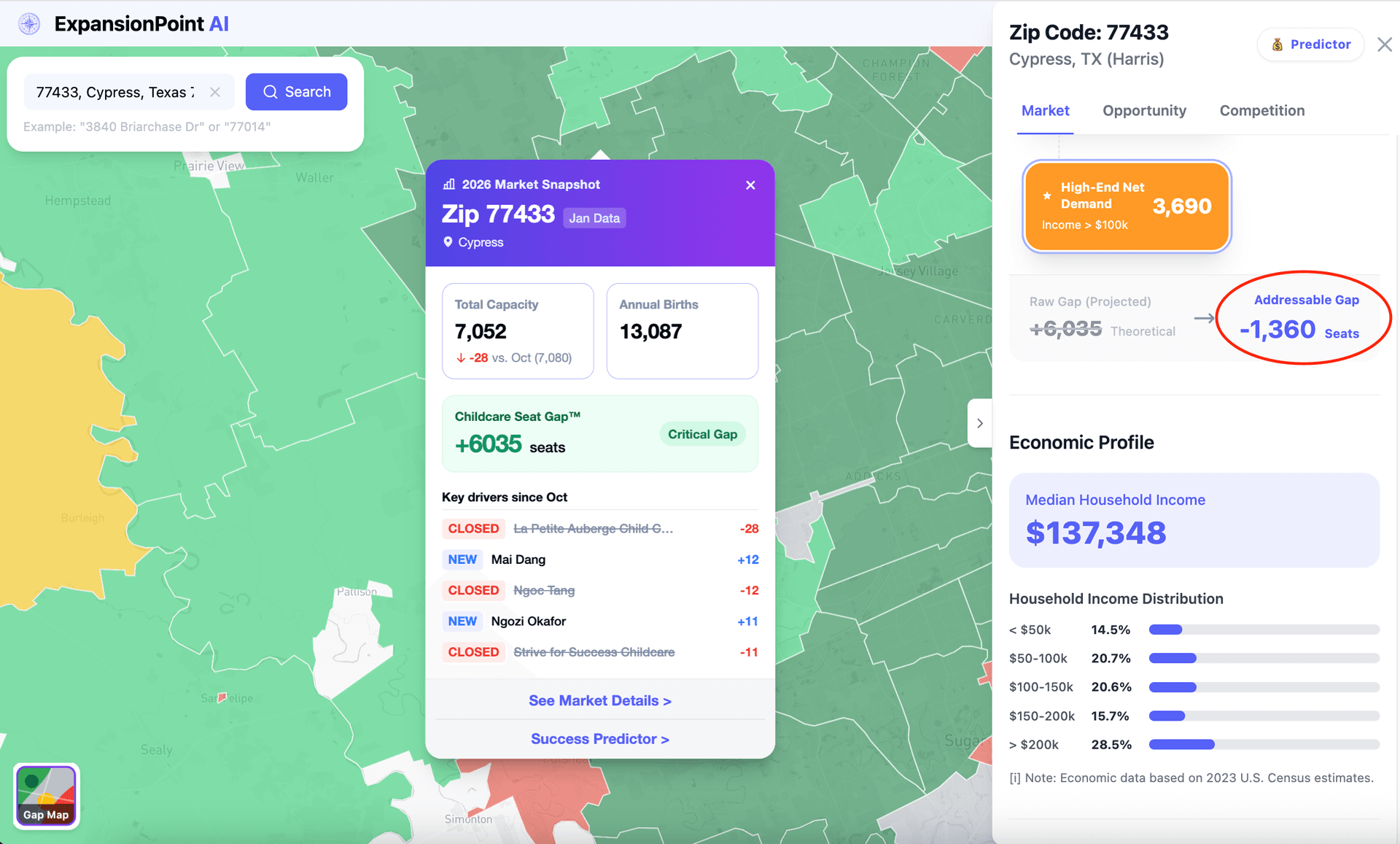
For example, in Cypress (Houston, TX), the raw population of kids under five is 13,087. While this massive number suggests strong demand, the reality is more complex: there are 71 daycares with 7,052 total capacity. However, when we apply the Nanny Filter and calculate the Addressable Seat Gap (ASG), the result is -1,360 (Oversupply). You can view the Cypress Market Snapshot here to see more details.
| Area (Zip) | Kids under 5 | Total capacity | Addressable Seat Gap |
| Cypress (77433) | 13,087 | 7,052 | -1,360 (Oversupply) |
A negative or marginal ASG indicates structural oversupply, which significantly compresses projected daycare investment ROI in Texas, regardless of the operator's brand strength. If your investment thesis relies on unadjusted census totals, the analysis lacks a structural defense. Understanding these macro variables is the first step in determining if buying a daycare in Texas is a good investment.
Step 2: Strategic Positioning and Tuition Alignment
Market saturation is rarely a total lack of children; it is typically an affordability mismatch. Underwriting must identify local coverage—where household income aligns with your tuition requirements.
In Texas sub-markets where median household is $80,000, a tuition of $1,800 per month often creates immediate enrollment friction. Tuition pricing is not a branding choice; it is a strict function of micro-market alignment.
You must evaluate competitors with clinical detachment. This means analyzing data like a doctor reviews a medical record—strip away emotion and focus on facts. Positioning extends beyond pricing. Different franchises represent distinct values and educational approaches in the local market. Many investors prefer proven franchise models to avoid the complexities of curriculum development, but the key is to choose a model you believe in that also meet local parental expectations.
Step 3: Childcare Labor Ratios and Classroom Economics
Childcare profitability depends on the fixed math of labor ratios. Hidden traps exist if you fail to account for how classroom configurations and teacher-to-child ratios impact your financial cash flow.
For instance, a room of 10 infants requires 3 teachers (as 2 can only cover 8), meaning your actual ratio is 1:3.3 rather than the 1:4 maximum. The objective is to design a classroom mix that aims for maximum feasible efficiency while building in a buffer for operational volatility.
The best practice is combining hyper-local market conditions—specifically age-segment breakdowns and competitor saturation—to scientifically design your total capacity and classroom mix. For example, if your catchment area has a deficit in infant care but is saturated in preschool, your underwriting must account for the higher labor costs associated with a high-infant mix.
Structural profitability requires a precise mix. High-revenue infants must be balanced with high-margin preschoolers based on local demand.
| Age Segment | Ratio | Max Group Size |
| 0 – 11 Months | 1 : 4 | 10 |
| 12 – 17 Months | 1 : 5 | 13 |
| 18 – 23 Months | 1 : 9 | 18 |
| 2 Years | 1 : 11 | 22 |
| 3 Years | 1 : 15 | 30 |
| 4 Years | 1 : 18 | 35 |
| 5 Years | 1 : 22 | 35 |
| 6-13 Years | 1 : 26 | 35 |
Step 4: Physical Facility Ceilings and Hard Asset Constraints
Beyond staffing, specific physical requirements dictate the absolute capacity ceiling. Texas Chapter 746 standards impose strict space and fixture mandates that directly impact capital expenditure (CapEx). If an asset fails these hidden metrics, the license may be denied regardless of the purchase price.
| Hidden Metrics | Requirement |
| Indoor Space | 30 sq. ft. per child |
| Outdoor Space | 80 sq. ft. per child AND 25% of your licensed indoor capacity |
| Toilets & Sinks | 1 per 17 children(18 mo+) |
These metrics act as a non-negotiable floor for investment. A building that appears large may have a low legal capacity due to bathroom counts or unusable square footage. Underwriting must account for the cost of bringing a facility into compliance before the first dollar of revenue is earned.
Step 5: Daycare Investment Entry Models
Acquisition: The Seller's P&L Normalization
Underwriting centers on stripping away discretionary spending to find true EBITDA. However, current profitability is a misleading signal if the future supply pipeline (new permits within 3 miles) indicates an expanding competitive set.
Before the LOI stage, buyers often struggle with ”valuation friction.” Incomplete data makes it hard to pin down a fair price.
In these cases, savvy investors leverage market saturation and surrounding competition data to justify a reasonable acquisition multiple when negotiating with brokers and sellers. See full case study in Waxahachie.
Lease-Up: The Ramp-Up Curve
Opening a new center through a lease requires a focus on rent coverage and the ramp-up curve. Predicting enrollment rates in a new market requires a deep look at existing local demand. Stress testing the EBITDA margin against a slow start is mandatory. The lease price must allow the business to survive a delayed break-even month.
Ground-Up: Equity Anchors and Monthly Gravity
Building new or buying land presents the highest capital risk. Investors often use SBA loans to leverage these projects, creating a significant "Monthly Debt." For example, in an $8.6M ground-up land project, a $6.9M loan creates a fixed monthly burden of approximately $50,000. This debt service is non-negotiable; whether you have 1 child or 200, the bank takes this first.
In this high-risk scenario, comprehensive underwriting is essential—relying on a single population trend is insufficient to secure your personal capital commitment.
Conclusion: The Five-Factor Underwriting Stack
To evaluate any childcare asset in Texas, we apply the Five-Factor Underwriting Stack:
- Addressable Seat Gap: : Calculating the localized delta between gross population and effective supply, adjusted for the "Nanny Filter."
- Strategic Positioning: Aligning tuition requirements with localized wealth pockets to ensure long-term enrollment stability.
- Optimal Capacity & Room-Mix Design: Designing classroom geometry to maximize labor efficiency within the constraints of the Texas Ratio.
- Future Supply Pipeline: Identifying upcoming permits and invisible competitors before they dilute the existing market share.
- Monthly Debt Test: Stress-testing the non-negotiable debt service against slow-start scenarios, especially in high-leverage land acquisition projects.
Together, these five layers determine whether a daycare investment is structurally viable in a specific location.
Where the Market Signal Snapshot Fits
Before performing a full underwriting analysis, investors typically start with market viability screening. Our Market Signal Snapshot focuses on the three market-side filters in the underwriting stack:
- Addressable Seat Gap
- Nanny Filter Adjustment
- Future Supply Pipeline
A daycare investment rarely fails because of population.
It fails because the underwriting ignored structural signals.