Daycare Franchise ROI: Primrose vs. Goddard vs. Kiddie Academy
Is a daycare a good investment in Texas?
Yes, but only if your underwriting passes three thresholds:
- Revenue > $2M
- Occupancy cost < 18% of Revenue
- Strong 10-min demand base
Otherwise, most new centers struggle in the first 24 months. So how do you actually choose the best daycare franchise in Texas? The answer is not brand — it’s underwriting.
Below is a financial and real estate underwriting breakdown of three dominant U.S. childcare franchises: Primrose, The Goddard School, and Kiddie Academy — with direct implications for Texas investors.
Daycare Franchise Cost & Entry: From Lease to Own
When evaluating a childcare center in Texas, you are not just buying a school — you are structuring your exposure to daycare real estate. Whether you own the land or sign a 20-year lease, your choice dictates your long-term ROI.
FDD data reveals three distinct entry models. Choosing the right one is the first step in your underwriting process.
| Investment Strategy | Primrose | The Goddard School | Kiddie Academy | Asset Profile |
| Land Purchase & Build | $6.2M – $8.6M | $5.2M – $8.6M | $4.0M – $7.0M | Heavy Asset: High equity, high real estate control. |
| Lease & Conversion | $2.3M – $4.9M | $1.5M – $4.6M | $0.4M – $0.9M | Mid Asset: Lower entry cost, higher lease risk. |
| Build-to-Suit (BTS) | $0.7M – $1.5M | $0.9M – $1.4M | Starts at ~$0.4M¹ | Light Asset: Fastest ramp-up, landlord controls land. |
Source: 2025 Franchise Disclosure Documents (Reporting CY 2024).
¹ Build-to-Suit (BTS) ranges for Kiddie Academy are subject to site-specific negotiations and are not separately disclosed in standard FDD investment tables. Out-of-pocket costs for "turnkey" BTS locations may be as low as $0, typically comprising initial franchise fees and required working capital.
Underwriting the Difference: Lease vs. Build-to-Suit
- Lease (Traditional): You rent an existing building. You pay for the interior renovations (Tenant Improvements). This requires more cash upfront but keeps your monthly rent at market rates.
- Build-to-Suit (BTS): The landlord builds the center to your specifications. Your out-of-pocket cost is low—sometimes as low as $0 for construction. However, the landlord will charge much higher rent to recoup their costs.
Many people ask: Is it better to do a build-to-suit with a landlord, or build and own your franchised preschool?
As Samantha Martin, an SBA and franchise expert, rightly points out: “There’s no one-size-fits-all answer—but there is a right answer based on goals, capital, and long-term strategy.”
When looking at daycare investment in Texas, the real question isn't just "Lease vs. Own." Instead, you must ask:
- Speed: Do you want to open quickly with low cash (BTS)?
- Scalability: Do you want to preserve capital to open multiple centers (Lease)?
- Long-term Wealth: Do you want to build equity through land ownership (Build/Buy)?
Your answer dictates your capital stack. Once you choose your path, the next step is underwriting the return. Is a daycare a good investment?
Ramping Economics of a Daycare Franchise
Surviving the first 24 months is the ultimate capital test. Daycare investment underwriting in Texas must account for the initial scaling friction. Below is Kiddie Academy Ramping Performance (12-24 Months).
Average Ramping centers are open for 16.5 months and often face a "profit fracture." The bottom 25% of new centers lose an average of $53,000 per year. You need 24 months of cash reserves to survive.
The 2024 Goddard School disclosure reveals an extreme case: a new center opened in Q4 with an EBITDA performance of -481%. This is not a failure of the brand. It is simply the initial loss phase where your costs are 100% but your student count is near zero. But to get there, you must first survive months where your expenses are higher than your tuition income.
Daycare Franchise ROI: Comparing Mature Performance
Once you survive the ramp-up, the rewards are structural. To determine the true profitability of a daycare franchise in Texas, we must compare mature facilities. We standardized the data by deducting fees (9-11%) to reach an Adjusted EBITDA.
Below is a side-by-side breakdown of the daycare franchise cost and the EBITDA for these top-tier brands.
Core Metric Comparison (Mature Average)
| Financial Dimension | Primrose (Avg) | Kiddie Academy (Adj. Avg) | The Goddard School |
| Gross Revenue | $2,814,801 | $2,193,070 | $2,417,129 |
| Labor Cost % (with Taxes) | 44.8% | 45.9% | 44.0%² |
| Occupancy Cost % | 16.5% | 16.4% | 13.0% |
| EBITDA % | 18.1% | 16.5%¹ | 21.6% |
¹Kiddie Academy Adjustment: KA's EBITDA reflects a 9% deduction from its reported Gross Profit to account for standard Royalty and Brand Fund fees, aligning it with the net performance reporting of Primrose.
²Goddard Alignment: Goddard’s FDD reports base wages at 39%. For an apple-to-apple comparison with Primrose and Kiddie Academy, we have adjusted this to 44% to include estimated employer payroll taxes (FICA/FUTA/SUTA), which are historically categorized under "Miscellaneous" in Goddard's reporting.
The Survival Line & Occupancy Ceiling
1. The Revenue Ceiling
Primrose is the "Heavy Carrier." Its average revenue ($2.8M) is the highest because it targets 300+ seat facilities. The Goddard School and Kiddie Academy act as "Medium Vessels" (typically 180-240 seats).
Primrose wins on sheer volume. Goddard and Kiddie Academy win on location flexibility, fitting into high-density Texas neighborhoods where 1.5-acre lots are unavailable.
2. The Survival Redline
The redline is the minimum revenue needed to keep the lights on.
- Primrose: $2.0M Redline. Below this, margins drop from 22% to 11%, leaving little room for loan payments.
- The Goddard School: $1.9M Redline. Because Goddard has higher total brand fees (11%), it requires a higher revenue floor to protect its bottom line.
- Kiddie Academy: $1.6M Revenue Floor. While this is the lowest threshold for operational stability among the top three, it offers the thinnest margin for error. In the daycare world, rent and debt are your "rigid enemies." Because these fixed costs stay stagnant even as enrollment dips, dropping below this redline flips your operating leverage—and profits evaporate instantly.
3. The Occupancy Ceiling
In daycare investment underwriting, rent is your most rigid enemy. The Goddard School is the efficiency leader at 13% occupancy, while Primrose and Kiddie Academy sit at ~16.5%.
In Texas, if your occupancy costs exceed 18%, you are operating in the danger zone. While you might still see a small 11% net profit, you are working with almost zero margin for error. As a new investor, you must avoid high-rent deals that force you to pay the landlord and the bank before you pay yourself.
4. The Survival Math
45% (Labor) + 10% (Brand Fees) + 10% (Operating) + 18% (Rent) = 83% Total Expense.
This leaves a thin 17% EBITDA to cover interest, taxes, and principal payments. The pressure is clear. While many ask about the average daycare franchise owner salary, the truth is that your income is a function of your Debt Service Coverage Ratio (DSCR).
A 17% EBITDA leaves very little margin after debt service. This means your only defense is precise site selection and continuous market monitoring. Your success is tied directly to the underlying real estate - the "dirt" - you choose. To secure a real return on your investment, you must use data to ensure you hit the Top Tier revenue lanes ($3.7M+).
Below is the underwriting breakdown for Market Risk and Site Selection.
Market Risk: Market Demand vs. Net Absorption
When evaluating a daycare investment, most partners cite gross population growth. However, professional investors look for Functional Seat Gaps, which often contradict raw numbers.
This creates a Demand Paradox. Using Texas as our primary case study, the data reveal a startling contrast:
- Cypress, TX (77433): Boasts 13k children under five, yet only ranks 5th in seat gap (5.8k missing slots).
- Dallas, TX (75217): Has fewer kids (9.4k) but ranks 1st in the seat gap with 7.3k missing slots.
Beyond raw gaps, you must underwrite the "Nanny Filter." In high-wealth corridors, families often bypass center-based care for home-based nannies. This can erode your addressable demand by up to 30%, regardless of your brand’s reputation. In markets like Katy, high-volume supply pipelines can lead to saturation even while the population continues to climb.
The Pivot: From Macro-Market to Micro-Site Positioning
Identifying a high-demand submarket is only half the battle. Once you know where to invest, you must determine which specific corner will capture the tuition dollars. Market selection identifies the opportunity; site selection secures the survival margin.
Site Selection: The 10-Minute Demand
While 1-3-5 mile radii are industry standards, they represent a static view of a dynamic market. Real families in Texas operate on drive-time patterns.
The 10-minute drive-time zone is the "must-win" area for an owner. These are the families that provide the stable enrollment base needed to cover your monthly debt. The 15-to-20 minute zone represents potential growth and additional capture.
The Mobility Advantage: To maximize enrollment speed, a site is optimally located on the "going home" side of a major road. In the evening rush, convenience is the ultimate currency. A center that is 3 miles away but requires a difficult U-turn or a left-hand turn against traffic is often ignored by parents. In Texas daycare underwriting, mobility layers—the ease of access—are more critical than simple geographic distance.
Positioning: Tuition vs. Local Income
You found a massive seat gap. You found the perfect corner. But here is the final, most expensive question: Can the local families actually afford your tuition?
High-end franchises need specific income levels to support their tuition. If a market has a median income of $80,000, a $1,800 monthly tuition creates friction. Positioning is the alignment of your care model with the local wallet. You must look beyond the broad median household income and deep-dive into specific census tracts to find the optimal location.
Case Study: The Round Rock 78664 Paradox
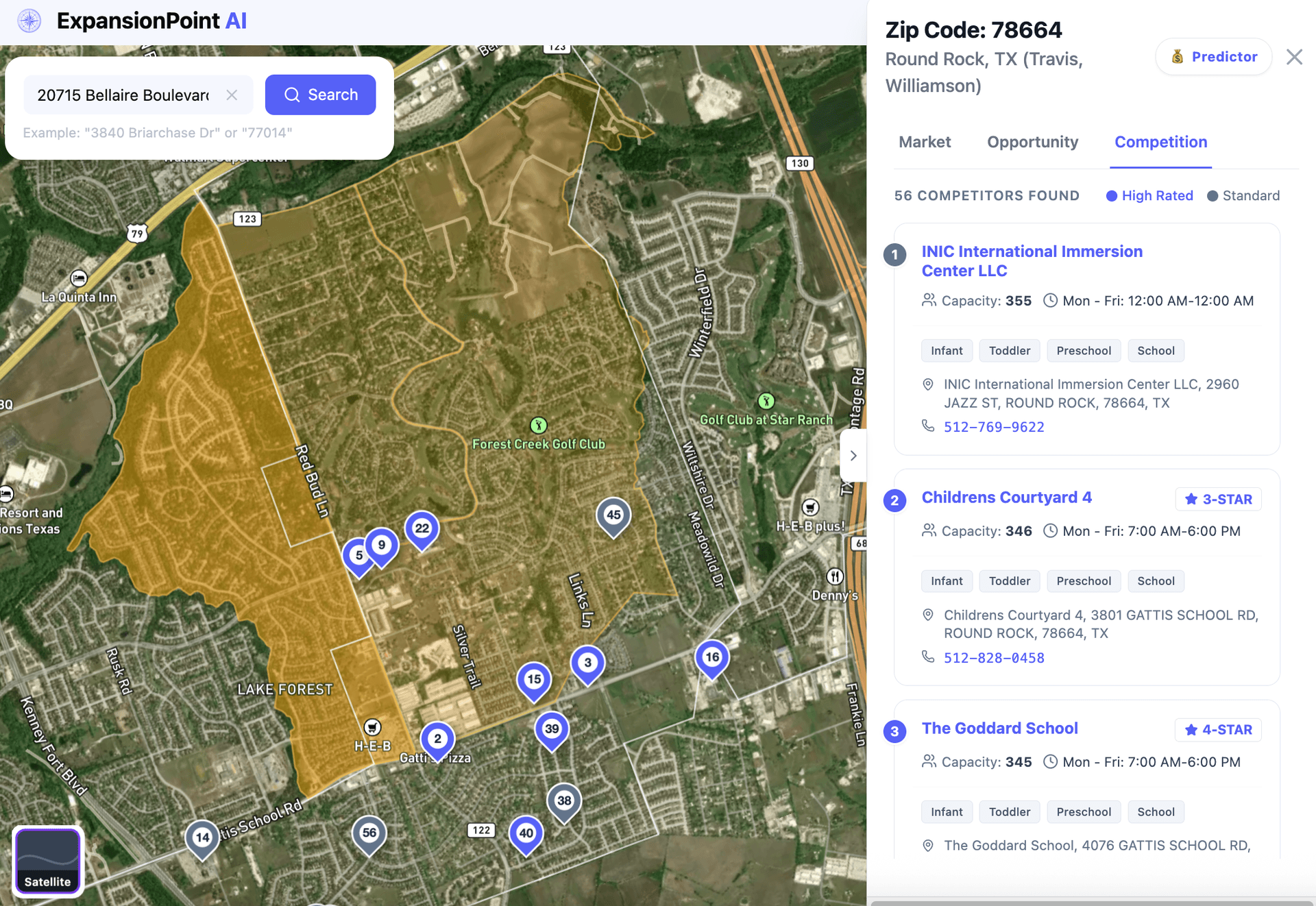
Look at Round Rock (Zip 78664). Based on Census 2024 data, the Median Household Income here is $85,919.
For a brand requiring high tuition, an $85k median might trigger a "red flag." But the Zip Code is only the first filter. The real insight comes from the Census Tract overlay.
When we look closer, we see a Demand Paradox. While 24.5% of the zip code earns under $50k, nearly 25% of households earn over $150,000. Premium franchises are not placed randomly. They cluster along high-traffic corridors like Gattis School Road, strategically positioned to intercept the wealth flowing from affluent subdivisions bordering the Forest Creek area.
In these specific tracts, the median income jumps to above $150,000, creating a perfect "Tuition Lane" within an otherwise average area. As shown in the image above, franchise centers are strategically located exactly where the wealth is concentrated.
Conclusion: Closing the Seat Gap
The "best" daycare franchise in Texas is not a universal constant. Each brand serves a different investment profile—whether you are prioritizing high-volume gross revenue or high-margin operational efficiency. Choosing the right franchise is not about following a trend; it is about aligning a brand’s specific model with your financial goals.
Ultimately, success is not found in a brand’s national headquarters. It is found in the structural signals of a specific 10-minute drive-time zone.
As our underwriting shows, the margin for error is razor-thin. With a 17% EBITDA and high occupancy costs, you are not just managing a school—you are managing a high-leverage financial asset. Relying on a brand's reputation without hyper-local data is a strategy based on hope. In the Texas market, the difference between a $6.4M alpha asset and a permanent operational struggle is not a demand gap—it is a data gap.
Next Steps for Your Underwriting
Before you sign a 20-year lease or commit millions in capital, you must validate your Survival Margin.
- Verify the Occupancy Ceiling: Ensure your rent-to-revenue ratio stays below the 18% danger zone.
- Run the Functional Seat Gap: Move beyond Zip Code averages to find the true "Tuition Lane" at the census-tract level.
- Stress Test the Ramping Phase: Plan for the initial cash outflows with precise market-absorption data.
Looking at a deal right now? Send me the location — I can quickly tell you if the demand actually supports it.