Daycare Investment & Market Analysis: Pflugerville, TX (Zip 78660)
- Audit Status: Available / Verified
- Market Data Freshness: Jan 2026 (Texas HHSC Licensing & Demographics)
- Last Reviewed: March 18, 2026
Designed for use by buyers, lenders, and brokers during SBA underwriting
Data sources include ACS, Texas HHSC, public filings
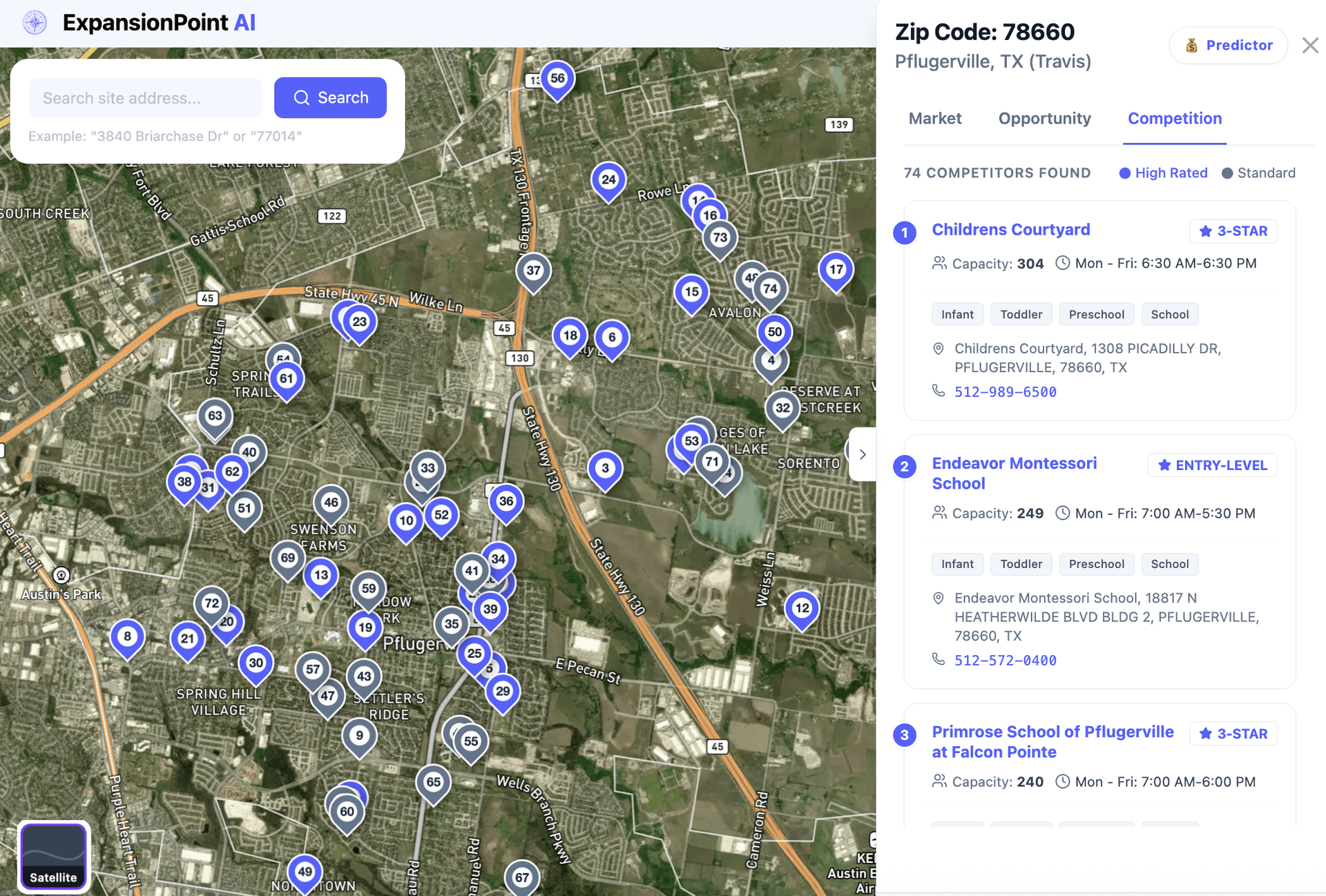
Market Read: Demand Signal With Active Operator Presence
Pflugerville’s 78660 market continues to show a strong childcare demand signal, supported by a large base of young families and steady residential growth across the area.
Capacity comparisons currently indicate a substantial seat gap.
After accounting for working-parent participation and informal care patterns, the practical addressable gap appears more moderate but still meaningful for operators.
Recent openings and brand expansion activity suggest the market is already on the radar for several established childcare groups.
These programs typically enter markets where long-term enrollment demand is expected to remain stable.
For investors evaluating opportunities in the area, the demand signal remains supportive.
However, future supply additions will likely shape how quickly the remaining gap translates into sustained enrollment.

Deal Read: Real Estate Value vs. Business Value
1. Strategic Positioning: Real Estate-Heavy Asset
This is a real estate-driven deal. Out of the $4.5M asking price, $3.4M (75%) is for the land and building. The business value ($1.1M) is tied to a physical asset that you own, rather than a leased space.
Physical land supports expansion, but actual capacity increase is subject to local zoning, licensing ratios, and permitting approval.
2. The Price Multiple Reality: 12.5x vs. 3x
The total asking price is 12.5x SDE ($4.5M / $360k). However, when you separate the real estate, you are acquiring the daycare operations at approximately 3.0x SDE. The premium is in the 2.1 acres of land and the 10,000 SF facility. This low-density footprint provides the physical capacity to expand the building or increase licensed enrollment in the future.
3. Who is this deal for? (Operator Fit)
- Best For: Buyers who want to own the underlying real estate. It is designed for those looking to put capital into a high-demand area while gaining the ability to expand the facility's capacity on the existing 2.1-acre lot.
- Key Consideration: Given the $4.5M entry price, this deal requires significant upfront capital or high debt-service coverage. It is a large-scale play involving a 10,000 SF facility, which typically requires a more robust management structure than a smaller, single-site school.
Deal Intelligence
Risk Snapshot
- Pricing Risk: Low–Moderate (Asset-Backed)
- Capital Intensity: High (Asset heavy)
- Supply Risk: Medium (active brand expansion)
- Execution Risk: Medium (multi-site + scale)
- Expansion Risk: Uncertain (zoning / licensing dependent)
Deal Summary
A real estate-driven acquisition in a high-demand market, where value is anchored in land ownership rather than current cash flow.
At current pricing, the deal relies on:
- long-term enrollment stability
- or future expansion to justify returns
Best suited for buyers prioritizing asset ownership and multi-site scaling.
Return Drivers
- Stable cash flow from existing operations
- Real estate appreciation in high-growth Austin suburb
- Potential NOI increase through capacity expansion (Requires additional capital and local approval)
How This Snapshot Is Used in Deals
This snapshot helps anchor pricing conversations and reduce information asymmetry during the deal process.
It is most useful when:
- Buyers need to validate location depth before committing capital.
- Lenders require independent saturation risk assessment for SBA underwriting.
- Franchise committees demand third-party market validation.
- Price negotiations stall over real estate vs. business value.
Disclaimer: This is a data-driven market reference designed to facilitate objective underwriting, not financial advice.

When deeper questions come up
When the snapshot isn’t enough, a Site Report helps clarify:
- Whether there is real, addressable demand to support enrollment — or if the market only looks fine on paper
- Where capacity pressure actually exists, and where it doesn’t, across the surrounding zip codes families realistically choose from
- Whether nearby providers — centers, home-based care, and nannies — are already absorbing demand before it reaches the market
- How drive-time patterns and household profiles shape who would realistically enroll
- Early market signals (recent openings and closures) that may impact enrollment stability over the next 12–24 months