Daycare Investment & Market Analysis: Richmond, TX 77407
- Audit Status: Available / Verified
- Market Data Freshness: Jan 2026 (Texas HHSC Licensing & Demographics)
- Last Reviewed: March 18, 2026
Designed for use by buyers, lenders, and brokers during SBA underwriting
Data sources include ACS, Texas HHSC, public filings
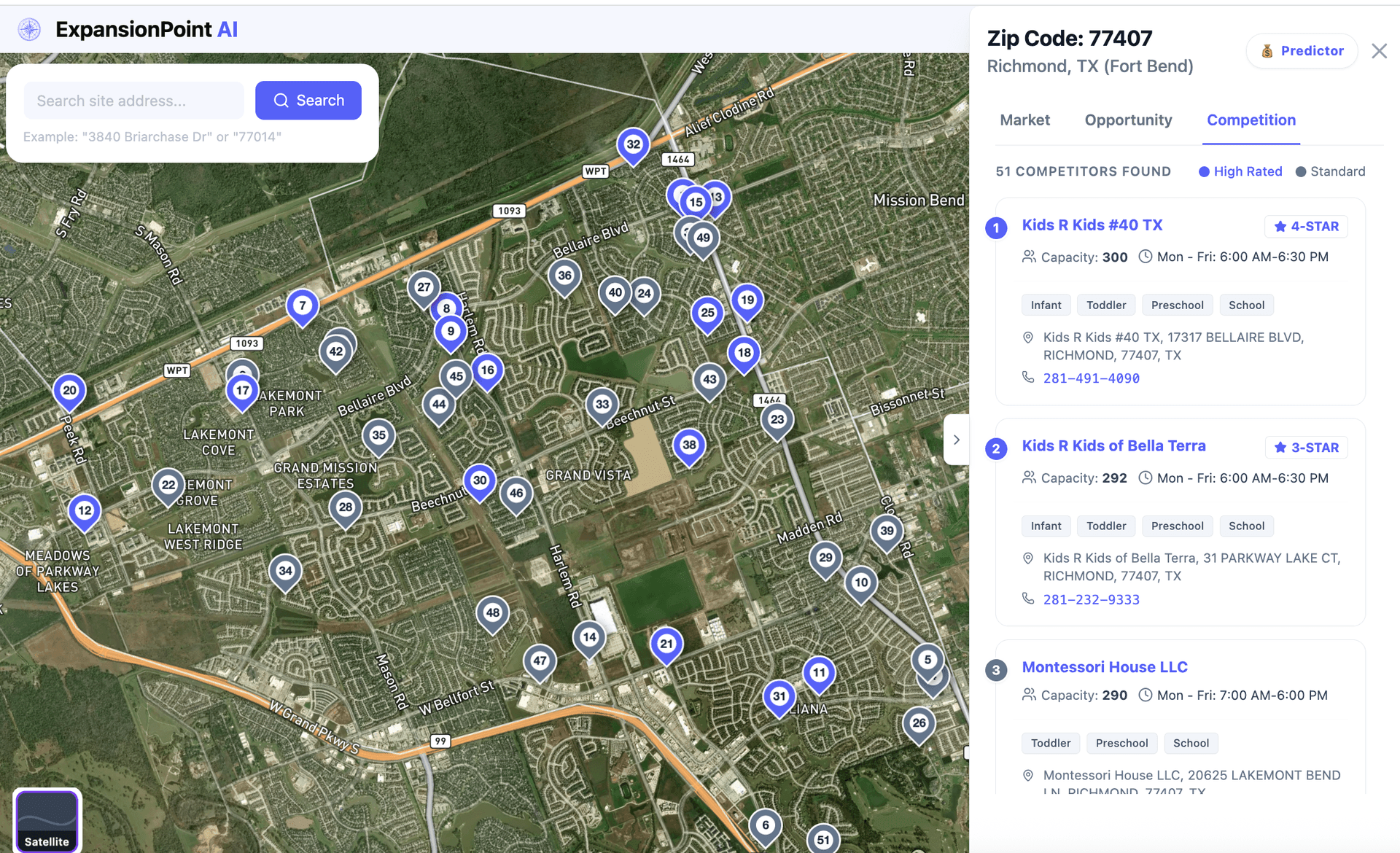
Market Read: Competitive Market, High Population Density
Zip 77407 shows a large childcare-age population and above-average household income levels within Fort Bend County.
Recent capacity additions, including new premium center openings, have meaningfully reduced the addressable seat gap at the zip-code level.
This market should be evaluated with attention to pricing assumptions, competitive positioning, and enrollment capture dynamics, rather than relying on raw population or seat-gap indicators alone.

Deal Read: The Micro-Market Collision (Asset vs. Lease)
1. The Turnkey Dilemma: Premium Asset, Zero Cash Flow (Listing A)
At $4.45M ($375/SF), Listing A offers a 2022-built, fully equipped 11,852 SF facility. The premium paid is strictly for speed-to-market (bypassing 18-24 months of construction).
- The Valuation Reality: Current SDE is $0. While the zoning allows for multi-use, gutting a specialized childcare build-out (small plumbing, commercial kitchen, playgrounds) destroys the acquired FF&E value.
- Expansion Limits: The 1.23-acre lot appears heavily optimized by the existing 11.8k SF footprint, 40 parking spaces, and required playgrounds.
2. A Definitive Pricing & Supply Signal (Listing B)
The FM 1464 lease listing ($35/SF NNN) reveals a critical supply shock: a newly constructed 200-seat Montessori is slated for Q4 2026 delivery, triggering immediate pre-enrollment competition.
- Proximity to Wealth Pockets: Listing B is strategically positioned near the southern Aliana demographic cluster, where median household incomes peak above $146k.
- Synergistic Play: For ancillary businesses (pediatric dentistry, tutoring, martial arts), this space offers a built-in daily pipeline of 200 high-income families.
3. The 77407 Math: A Closing Window
While these two sites are 19 minutes apart, they draw from the same zip-code-level demand pool. ExpansionPoint data currently shows an Addressable Seat Gap of 328 seats. Once the incoming 200-seat Montessori (Listing B) opens, the remaining zip-code gap compresses to a razor-thin ~128 seats, leaving minimal margin for organic absorption.
Deal Intelligence
Risk Snapshot
- Pricing Risk: High (Paying $4.45M stabilized pricing for a zero-cash-flow asset).
- Capital Intensity: Very High (Asset price + extensive operational runway needed for the 12-18 month enrollment ramp-up).
- Supply Risk: Critical (Confirmed 200-seat premium addition compresses the remaining zip-code gap to nearly 100 seats).
- Alternative Use Risk: High (Repurposing Listing A destroys the premium paid for existing FF&E and specialized build-out).
Deal Summary
Richmond 77407 is a high-stakes market transitioning from expansion to rapid saturation. The mathematical reality (a remaining gap of ~128 seats post-2026 pipeline) dictates that raw demographic growth is no longer a safety net. Acquiring the turnkey asset (Listing A) requires deep working capital. Success here is a pure "market-share capture" play, demanding a highly experienced operator who can aggressively out-market competitors to pull from the southern wealth pockets.
Return Drivers
- Real estate appreciation within Fort Bend County's high-income corridors.
- Speed-to-market advantage (avoiding 2026+ construction cost inflation).
- Aggressive enrollment capture through dominant brand positioning.
How This Snapshot Is Used in Deals
This snapshot helps anchor pricing conversations and reduce information asymmetry during the deal process.
It is most useful when:
- Buyers need to validate location depth before committing capital.
- Lenders require independent saturation risk assessment for SBA underwriting.
- Franchise committees demand third-party market validation.
- Price negotiations stall over real estate vs. business value.
Disclaimer: This is a data-driven market reference designed to facilitate objective underwriting, not financial advice.

When deeper questions come up
When the snapshot isn’t enough, a Site Report helps clarify:
- Whether there is real, addressable demand to support enrollment — or if the market only looks fine on paper
- Where capacity pressure actually exists, and where it doesn’t, across the surrounding zip codes families realistically choose from
- Whether nearby providers — centers, home-based care, and nannies — are already absorbing demand before it reaches the market
- How drive-time patterns and household profiles shape who would realistically enroll
- Early market signals (recent openings and closures) that may impact enrollment stability over the next 12–24 months